
Can you name a group of exercises that can be done by everyone, regardless of age or ability? That targets all muscle groups? With little or no equipment? Even if you haven’t heard of the word “calisthenics”, you’ve probably done at least some of these exercises, maybe even all of them. Squats, lunges, push-ups - they’re all part of the calisthenics family, a form of democratic strength training that can be done almost anywhere, making it ideal for kick-starting your January health and fitness routines.
“Calisthenics differs from regular body weight training because the aim is to increase overall body strength by focusing on bigger muscle groups, like hamstrings, glutes, quadriceps, back and chest,” explains Gabriela Zerger, Wellbeing Manager at Aspria Uhlenhorst. “But the biggest difference is the slow-motion nature of the exercises, meaning they are not cardio-based.”
What is calisthenics?
Whether you’ve been exercising your whole life or have decided to start your fitness journey today, calisthenics are a great way to train whatever your level and ambitions - and as a support to your favourite or regular workouts.
Calisthenics increase strength, fitness and flexibility through movements such as pulling, pushing, bending, jumping or swinging by using your own body weight for resistance. Basic exercises include press-ups, squats, lunges, sit-ups, tricep dips - although every exercise can be scaled up or down depending on ability. More advanced exercises include handstand push-ups, pistol squats and the human flag.
The benefits of calisthenics
Calisthenics improve coordination, balance and muscular endurance, whilst being gentler on the joints. “The movements also require full body tension, which ultimately means that core muscles are engaged throughout each exercise,” Gabriela explains. “One of the amazing benefits to calisthenics is that it targets all the muscles in the body. It also mimics everyday movement patterns - that kind of training is a great injury prevention method.”
Another great benefit of incorporating calisthenics into your workout is that most exercises can be done anywhere at any time, since no (or very little) equipment is required. So whether you are travelling, working from home, stuck in the office or a regular gym goer, calisthenics helps to keep you training.
So how do you know which exercises are best for you? Gabriela lists her top three for different age groups and abilities…
Calisthenics for beginners
Exercises for beginners include squats, push-ups and chin-ups. As you progress, consider adding jump rope, planks and crunches to your routine.
● Squats
Squats train the quads, hamstrings, calves, gluteal muscles and core. In order to perform a squat, stand with your feet hip-width apart. Lower your body by bending your knees until your bum is level with your knees, keeping your back as straight as possible. In order to keep your balance, engage your core tension by pulling in your belly button. Repeat 15-20 times per set.
● Push-ups
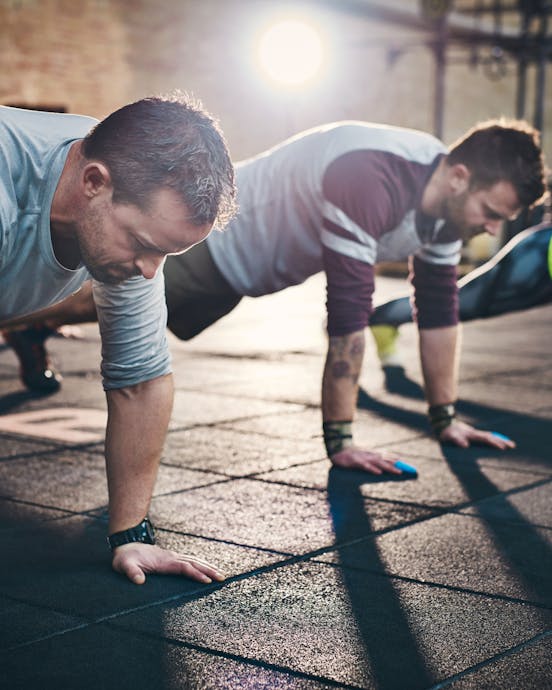
This exercise trains the chest, shoulders and triceps, and is an overall great exercise to practise body tension. Lie on your stomach. Now move your hands under your shoulders and spread your feet about hip-wide apart. Push yourself off the floor until your elbows are fully extended. Make sure you move your entire body up at the same time to prevent arching your back. Do as many repetitions as possible (AMRAP) and slowly build your rep count up. For more information on push-ups and general upper-body exercises, watch this video tutorial by some of our instructors.
● Chin-ups
Chin-ups work your upper back and arm muscles, specifically the biceps, forearms, shoulders and lats - they also engage your abdominal muscles. You’ll need a bar for this exercise, either at the gym (use banded assistance if this is difficult for you) or a bar inside a door frame at home. Keeping your feet hip-width apart, grab the bar with both hands, your palms facing towards you and arms shoulder-width apart. Pull yourself up until your chin is above the bar. Pause for a second, then lower yourself all the way back down in a controlled motion.
Calisthenics for seniors
Lunges (backwards and forward), step-ups and tricep dips are great exercises for older people who want to incorporate calisthenics into their routine. Assisted squats (standing up from a bench or chair), seated core twists and leg lifts can benefit balance and coordination.
● Lunges
Lunges help to strengthen and build several muscle groups, including your quads, glutes and hamstrings.They are also a great exercise to work on balance and coordination. In order to perform a lunge, pull your shoulders back and elevate your collar bone so that you stand straight. Stepping one leg behind the other, bend both knees until the back knee slightly hovers over the ground. The front knee should also be bent, and can move towards the toes, but not further than that. You should keep most of your weight on the front leg (the foot is flat on the ground) and keep your tummy tight for balance. Perform 10 per side and grow your repetitions from here.
● Step-ups
This is a wonderful lower body and back exercise that also works on coordination and balance. You can simply use a step, stool or chair to do this at home. If you’re a gym member, use a box. Stand in front of the stool or box with your feet hip-width apart. Step firmly onto the stool or box with your left foot, pushing with the front leg. Keep your balance by tightening your core and squeezing your glutes. Now step up with your right leg, to join your left leg on the box or stool. Return your right leg back to the floor in a controlled movement, followed by your left leg. Repeat 8 times, then switch your leading leg to the right. Repeat 8 times. As you build strength, you could add weights to your training.
· Tricep dips
Tricep dips are a great arm exercise that can also strengthen your shoulders. If you are at the gym you can use a bar or box; if you do this exercise at home you can use a regular stool or chair. With the stool behind you, place both hands on it. Keep both feet planted on the ground and lower your hip towards the floor, with your bum hovering above the ground. You want to keep your back close to the chair and your chest up. Repeat 12-15 times.
Incorporating calisthenics into your workouts
Given that calisthenics increase strength, fitness and flexibility, they should form the foundation of your workouts, especially strength training. But they help to support all daily exercise.
They can easily be incorporated into everyday fitness routines and practices. For example, you can incorporate weight training into a calisthenics session by adding dumbbells to some of the exercises. Or, you could start your training with a round of calisthenics, followed by a cardio workout, from gym sessions to swimming. Eric van Eyseren, swimming instructor at Aspria Royal La Rasante, and Francesca Meini, pool manager and experienced swimmer, recently shared their tips on how to get the most out of your time in the pool. There’s nothing quite like banishing those January blues by immersing yourself in the water.
If the addition of calisthenics into your routine prompts you to consider other new practices, take a look at our different training methods, where we help you work out which is right for you.
“There are no limits to your creative inclusiveness of calisthenics in your regular routines,” says Gabriela. “Just keep the fun and challenge when performing each exercise.” And get in touch if you’d like us to help create a tailored calisthenics workout just for you.
Related articles
fitness
The indicators you should take into account when aiming to set SMART fitness goals.
fitness
A quick and effective way to warm up at the beginning of your training session
fitness
Aspria instructors Caroline and Chady introduce you to their favourite 3 strength exercises


